From Line to Grid
Two visual formes of writing, between line and perception
My graphic work revolves around two distinct yet deeply interconnected visual styles. One is based on the clarity of line and the rigor of construction, the other explores fragmentation and the perception of the image.
These two approaches are not opposed. They engage in a dialogue. They both reflect a shared quest for balance between structure and tension, between what is immediately legible and what is gradually revealed to the eye.
Linear Expression
The Linear Expression falls within a geometric approach to drawing, similar to "ligne claire." Forms are constructed exclusively from straight lines, organized according to different orientations to create a composition that is both structured and fluid.
The line, typically black, acts as a framework. It defines contours, sets the rhythm of the image, and guides the viewer's eye. Color then intervenes in flat, often vivid, areas, bringing contrast, legibility, and presence.
This graphic language is based on a simple constraint—the straight line—which becomes a tool for exploration. By limiting the gesture, it paradoxically opens up a field of possibilities, where every variation in angle, rhythm, or proportion contributes to the overall balance of the image.
The whole produces compositions that are both sharp and expressive, where formal rigor does not exclude sensibility.
Perceptual Grid
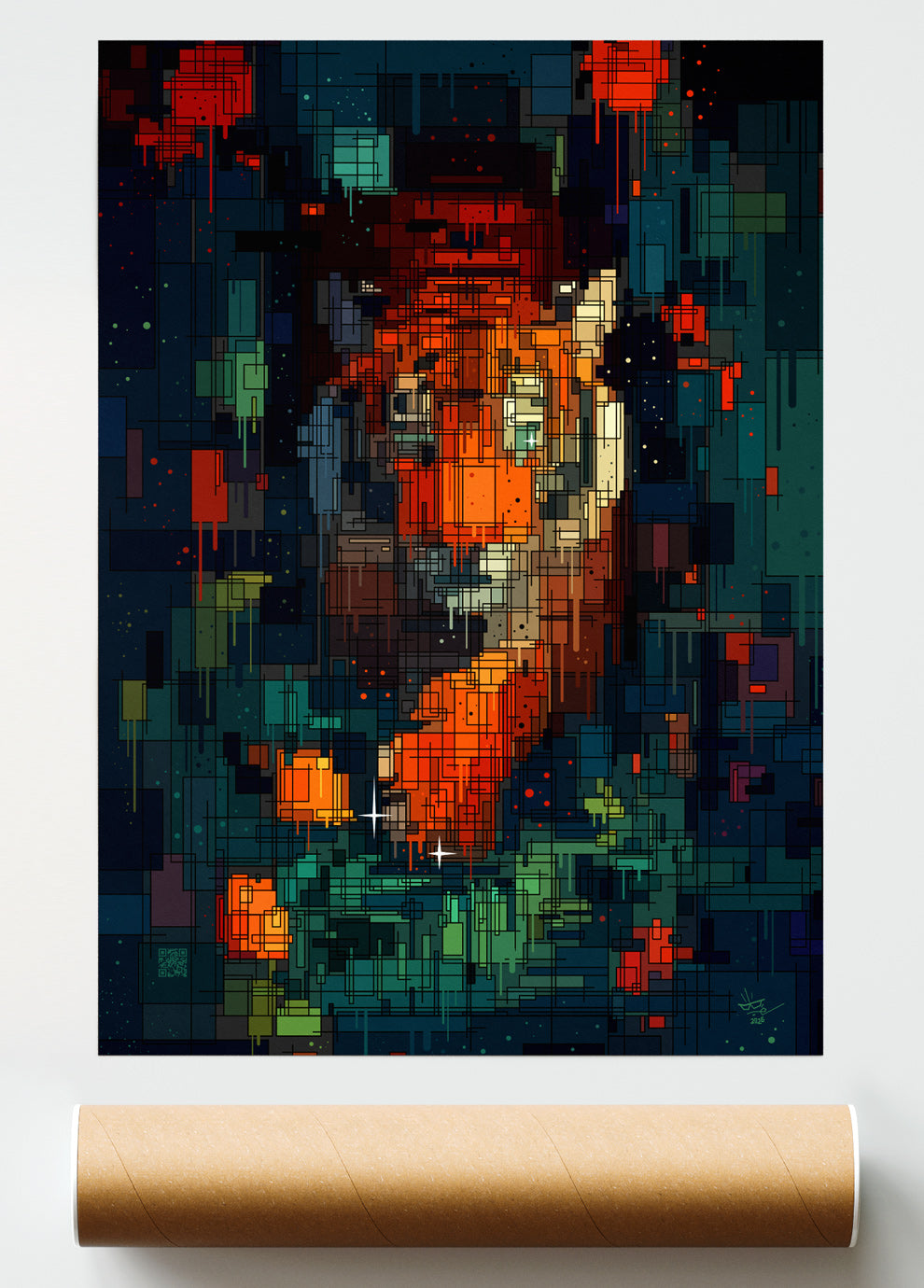
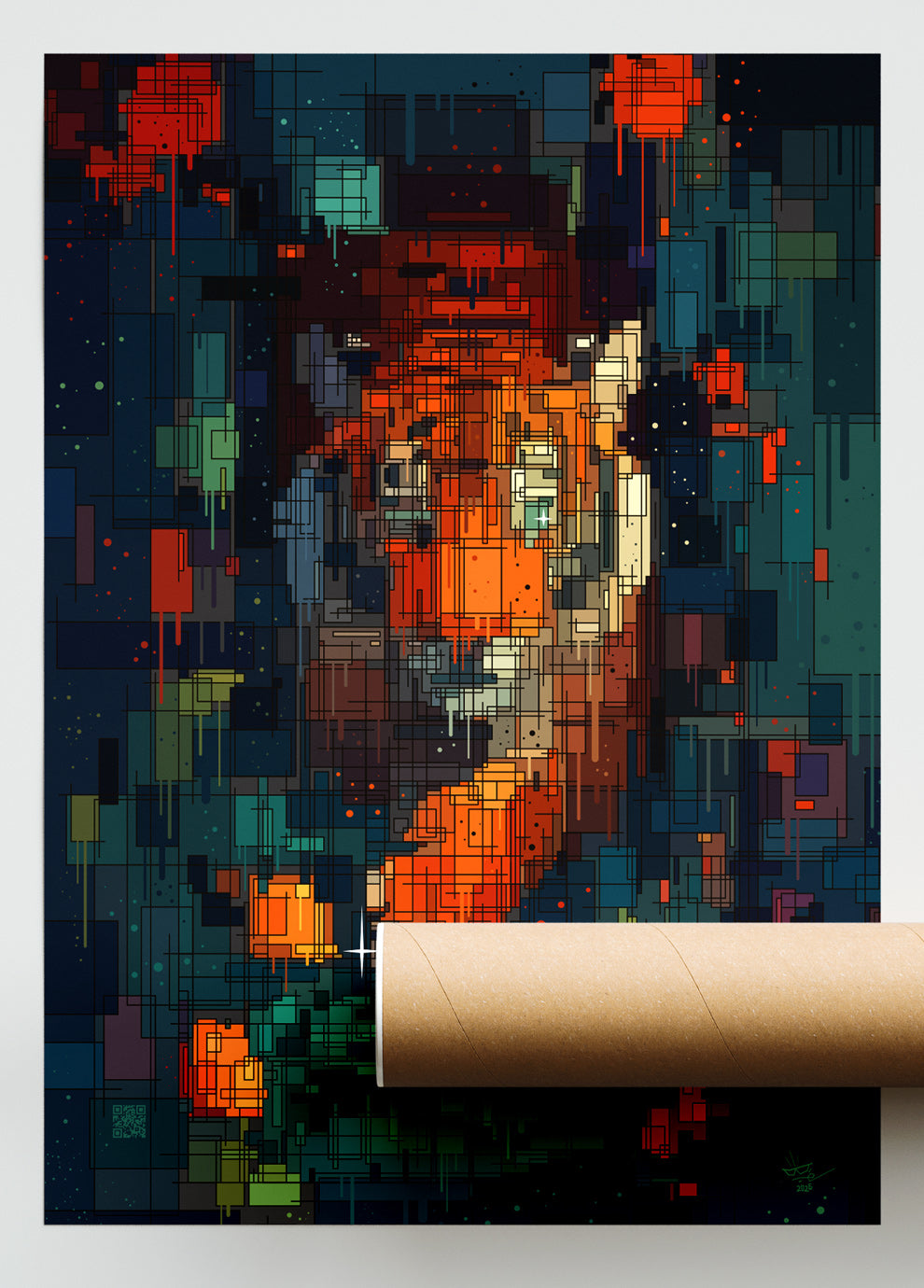
With the Perceptual Grid, the relationship to the image evolves. The drawing is no longer immediately given: it is constructed in the eye of the beholder.
The compositions are based on a network of intersecting horizontal and vertical lines, fragmenting the image into a multitude of segments. This grid acts as a filter, an intermediate structure between the subject and its perception.
Depending on the distance, the eye perceives different things. Up close, the image appears almost abstract, composed of lines and breaks. Moving further away, forms appear, recompose, and become legible.
This interplay between fragmentation and revelation places the viewer at the heart of the visual experience. The image is no longer just viewed: it is mentally reconstructed.
Inspired by the logic of pixels and modular structures, this approach questions how we perceive and interpret forms.
A Common Quest
Despite their differences, these two styles share a common intention: to structure the image while allowing for an evolving interpretation.
- In the Linear Exression, clarity arises from construction.
- In the Perceptual Grid, it emerges from perception.
One asserts, the other suggests. One guides the eye, the other challenges it.
Together, they explore an essential tension: that between order and instability, between control and interpretation.
Towards a Visual Language
These two approaches are not fixed. They evolve, feed into each other, and open up new avenues.
They form the basis of a broader exploration around the image, its construction, and its interpretation.
Because beyond forms and systems, what interests me remains constant: to create images that do not fully reveal themselves at first glance, but rather invite exploration and renewed attention.
To continue
If these approaches resonate with you, you can explore them further through a selection of works from the Fine Art poster collection:
- Découvrir the prints (filter by style)
To learn more about my background, influences, and working methods:
- Visit the artist page
- Read the article : Appropriation, Transformation, and Perception