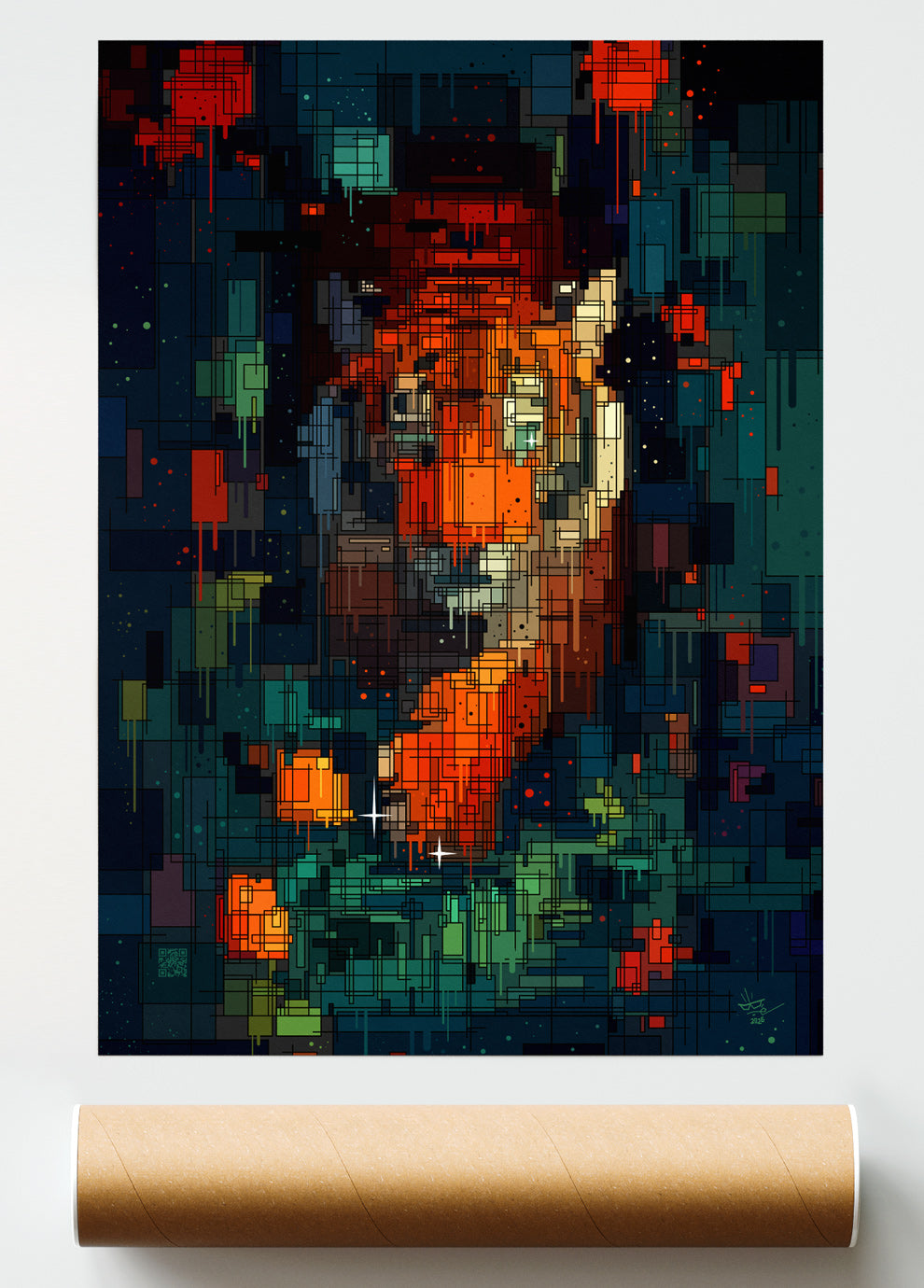
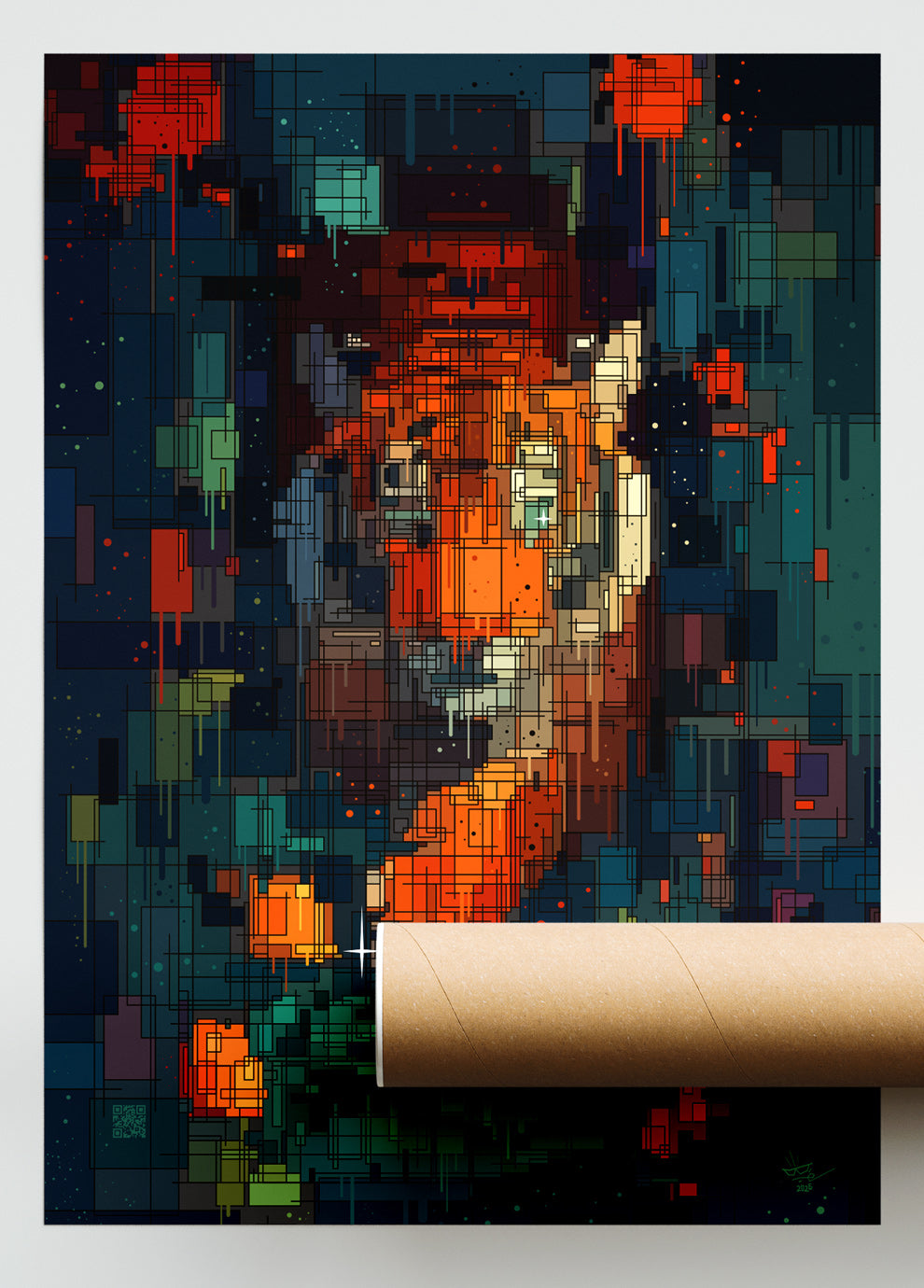
Appropriation, Transformation and Perception
Approach & Intent
Some images immediately feel familiar. Drawn from popular culture or significant references, they become deeply embedded in our visual memory.
But what happens to them when we approach them differently? When they are deconstructed, reassembled, permeated by a graphic style that alters their interpretation?
This article sheds light on an approach that explores these transformations, between appropriation, structure, and perception.

SHIFTING THE IMAGE
When a reference appears in my work, it is never considered a model to be reproduced. Rather, it acts as a starting point, a foundation from which a new interpretation can emerge.
What interests me is that pivotal moment when the image leaves its initial status to become a field of exploration. It is transformed, reorganized, permeated by a visual logic that modifies its balance.

BETWEEN APPEARANCE AND DISAPPEARANCE
An image can reveal itself in several ways depending on the distance and attention given to it.
At first glance, the subject may seem obvious. But upon closer inspection, this obviousness fragments, giving way to a more diffuse interpretation.
The gaze moves, hesitates, reassembles. This back and forth creates an evolving visual experience, where nothing is completely fixed.

A LOGIC OF TRANSFORMATION
Appropriation, in this approach, is based on a principle of transformation rather than reproduction.
An existing image becomes raw material. It is re-worked, redistributed, integrated into a system that redefines its rules.
This process introduces a shift: a reference is recognized, but it partially eludes, as if displaced into another register.
 GAZE AND PERCEPTION
This work is part of a broader reflection on how we look at images.
In a context where everything is instantly visible, the aim here is to propose another temporality. A way to slow down, to observe, to allow things to appear gradually.
The image does not reveal itself entirely. It requires involvement, attention.

A FILIGREE VISUAL LANGUAGE
Through this approach, it is about perception, visual memory, and transformation.
Between reference and reinterpretation, each creation seeks to open up a space for reading. A space where the image is never entirely fixed, but in constant redefinition.

TO CONCLUDE
This approach offers another way of engaging with images: less immediate, more progressive.
Between graphic structure and visual memory, it is about shifting the gaze, questioning what one thinks one recognizes, and exploring what reveals itself through observation.

TO LEARN MORE
If this approach resonates with your perspective, you can find it through a selection of works from the Fine Art poster collection:
- Discover the prints
To learn more about my background, influences, and working methods:
- Access the artist page
- Read the article: From Line to Grid
To look differently at what we think we already know.
To let the image transform with the gaze.